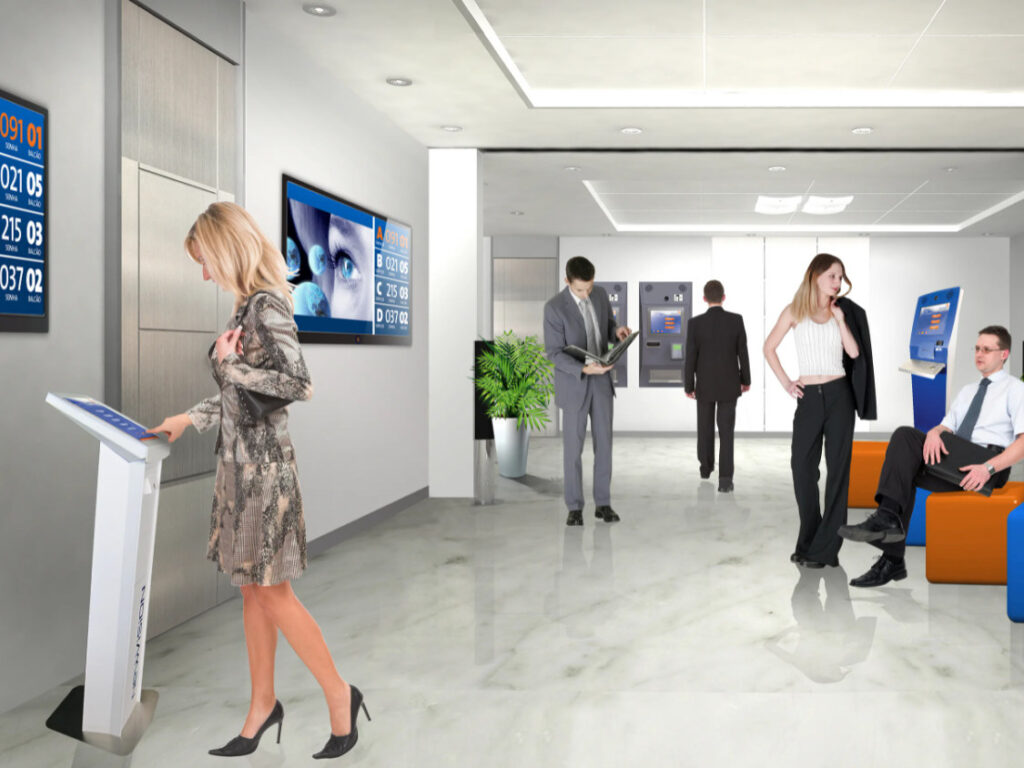
In today’s fast-paced world, long waiting lines are more than just an inconvenience—they are a major source of customer frustration and a significant drain on business productivity. Whether in a bank, a hospital, a government office, or a retail store, inefficient queuing can lead to lost customers, negative reviews, and operational chaos. A Queue Management System addresses these challenges by digitizing the waiting process, providing real-time updates, and empowering businesses to optimize service delivery. By streamlining customer flow, these systems reduce perceived wait times and free up staff to focus on service rather than crowd control .
The NextGen Technologies has established itself as a top company in this domain, delivering enterprise-grade Queue Management System solutions tailored to the modern enterprise. By integrating self-service kiosks, digital signage, and advanced analytics, we help businesses transform their customer journey from chaotic to controlled. For organizations ready to eliminate inefficiency, thenextgentechnologies.com is your essential partner .
Queue Management System in Riyadh: The Capital’s Standard for Operational Excellence
Riyadh, as the bustling capital of Saudi Arabia, is home to the headquarters of major corporations, government entities, and financial institutions. In this competitive landscape, customer experience is a key differentiator. A Queue Management System in Riyadh is not merely a tool for managing lines; it is a strategic asset that aligns with the Kingdom’s Vision 2030 goals of digital transformation and service innovation .
In sectors like banking and insurance, where footfall can reach 300 customers per day per branch, traditional queuing leads to bottlenecks. However, institutions like Al Rajhi Group have successfully deployed advanced systems featuring self-service ticketing kiosks and customized mobile apps. These solutions enable customers to book time slots remotely or take tickets upon arrival, drastically reducing in-branch congestion. The results have been transformative, cutting average wait times from up to 2 hours down to just 30 minutes .
Furthermore, Riyadh is leading the region in implementing large-scale flow management. The General Authority of Civil Aviation (GACA) is deploying LiDAR sensors and passenger flow analytics across 27 airports. This technology allows for real-time monitoring of bottlenecks at immigration and security, turning reactive management into predictive operations .
The NextGen Technologies brings this level of expertise to the Riyadh market. We offer high-performance timer and audio systems, virtual queuing, and seamless integration with existing Point of Sale (POS) systems. By partnering with us, Riyadh businesses can ensure they are not just keeping up with the capital’s rapid growth but setting the standard for service excellence.
Queue Management System in Saudi Arabia: Driving Vision 2030 Through Digital Innovation
The adoption of a Queue Management System in Saudi Arabia is accelerating rapidly, driven by the nation’s ambitious digital transformation agenda. From the healthcare sector to retail and government services, the Kingdom is moving decisively away from manual, chaotic queues toward smart, data-driven ecosystems .
The healthcare sector is witnessing a revolution. Hospitals are integrating queue systems with Hospital Information Systems (HIS) to manage patient flow from registration to pharmacy. This integration reduces staff workload and allows patients to track their status via mobile notifications, significantly lowering anxiety and improving care quality . Similarly, the government sector is digitizing citizen services; passport offices and labor departments are employing centralized dashboards to manage high volumes efficiently, ensuring transparency and fairness for all citizens .
The scale of this transformation is evident in national infrastructure projects. The simultaneous rollout of passenger flow technology across 27 airports—the largest deployment of its kind globally—demonstrates a commitment to using queue management not just for convenience, but for national efficiency and economic competitiveness .
The NextGen Technologies is proud to be a part of this transformation. We understand the unique challenges of the Saudi market, from the high volume of customers during peak seasons to the extreme climate that makes indoor, organized queuing essential. Our solutions are built to handle the scale of the Kingdom’s ambition, offering multi-location support, advanced reporting on peak hours, and robust security compliance to help you drive revenue and build customer loyalty .
Why The NextGen Technologies Is Your Top Partner for Queue Management
Choosing the right technology partner is crucial for successful implementation. The NextGen Technologies stands out as a top company due to our holistic approach to customer experience management. We don’t just provide a ticketing machine; we deliver a complete ecosystem.
Customized Solutions for Every Industry: We recognize that a hospital’s needs differ from a bank’s or a restaurant’s. We offer a range of solutions including self-service kiosks, appointment-based systems, and virtual queuing that allow customers to join a line remotely . Our systems support multi-location management, allowing you to monitor service efficiency across different branches from a single dashboard .
Data-Driven Insights: Our advanced reporting portals (Spectra) provide granular analytics on waiting times, service efficiency, and customer abandonment rates. This data allows management to make informed decisions about staffing and resource allocation, directly impacting the bottom line .
Seamless Integration and Support: We specialize in integrating our queue management software with your existing ERP and CRM systems, ensuring a smooth data flow and reducing administrative overhead . With our local expertise in the Middle East, we ensure rapid deployment and 24/7 technical support to guarantee your operations never face downtime.
For any organization in Saudi Arabia, particularly in Riyadh, looking to modernize their customer service, the choice is clear. The NextGen Technologies delivers the reliability, scalability, and intelligence required to succeed in the digital age. Visit thenextgentechnologies.com to schedule a demo.
Frequently Asked Questions (FAQs)
Q1: What is a Virtual Queue Management System, and how does it work?
A Virtual Queue Management System allows customers to join a queue remotely via a mobile app or website before arriving at the location. It eliminates physical crowding, provides real-time position updates, and sends SMS or push notifications when it is the customer’s turn to be served .
Q2: Can a queue management system integrate with my existing business software?
Yes. Professional systems offer robust API integrations. They can integrate seamlessly with your Point of Sale (POS), Hospital Information Systems (HIS), and CRM platforms to ensure a unified workflow and data consistency across your organization .
Q3: How does a queue management system improve staff productivity?
By automating the ticket distribution and customer calling process, staff no longer need to act as crowd managers. The system routes customers to the appropriate counter, allowing employees to focus entirely on service delivery and reducing idle time between customers .
Q4: Is it possible to manage multiple branches from one central location?
Absolutely. Modern cloud-based queue management systems offer centralized dashboards. This allows regional or corporate managers to monitor live service status, compare performance metrics across branches, and generate comprehensive reports without being physically present at each location .
Q5: How can my business reduce wait times using this technology?
By analyzing data from the queue management system, you can identify peak hours and service bottlenecks. This allows you to optimize staff scheduling, open additional service points during high traffic, and implement appointment-based queuing to level out demand throughout the day .