In the construction industry, certain terms appear frequently in project specifications and contractor conversations but rarely get explained to the people outside the field who need to understand them. Clearing and grubbing is one of those paired terms commonly referenced together because the two processes are inseparable in practice and critical to every development project.
In Houston, where the land development market operates at tremendous scale across a wide geographic footprint, Clearing and Grubbing Houston is performed thousands of times a year on parcels ranging from small urban infill lots to sprawling commercial sites. Understanding what these processes involve, why they must be done correctly, and what happens when they are skipped or done poorly is valuable knowledge for anyone involved in land development or construction.
Defining Clearing and Grubbing
Clearing and grubbing are two distinct but closely related processes that together prepare a site for construction by removing all organic matter and subsurface obstacles.
Clearing refers to the removal of all vegetation and surface debris from a designated area. This includes trees, shrubs, brush, grass, roots visible at or near the surface, logs, and any other plant material. The clearing phase addresses what is visible and accessible at ground level, creating an open, unobstructed workspace.
Grubbing refers to the removal of what clearing leaves behind below the surface specifically, root systems, stumps, buried logs, and other organic material embedded in the soil. Grubbing is the more intensive of the two processes because it requires going into the earth, not just working at its surface. The word itself derives from the act of digging or rooting around in the ground, which is precisely what the process involves.
Together, clearing and grubbing produce a site that is free of all organic obstructions both above and below grade a clean slate ready for grading, excavation, and foundation work.
Why Both Steps Are Necessary
A common misconception is that simply removing trees and brush from a site is sufficient to prepare it for construction. In reality, leaving root systems in the soil creates serious long-term problems.
Organic material in the soil roots, buried logs, decomposing organic matter continues to decay after clearing. As it decomposes, it creates voids in the ground. Those voids create differential settlement, meaning that different areas of a foundation may settle at different rates as some areas lose the soil support that was there before. The result can be cracking foundations, uneven floors, structural damage, and costly repairs.
For this reason, construction specifications for virtually any significant building project in Houston whether residential slab, commercial building, paving, or infrastructure require that the building footprint and any load-bearing areas be cleared and grubbed to a sufficient depth. The depth required varies based on soil conditions and the type of construction but is typically at least 12 to 18 inches below finished grade.
Beyond structural concerns, intact root systems from trees and vegetation can continue generating growth after clearing. Without grubbing, invasive species like Chinese Tallow can regenerate from remaining root mass, quickly recolonizing cleared ground and requiring repeated clearing efforts.
The Clearing and Grubbing Process in Houston
A professional clearing and grubbing operation in Houston begins with site planning and survey. Before any equipment rolls onto a site, the clearing crew assesses the existing vegetation, topography, soil conditions, and any obstacles utility lines, neighboring structures, preserved trees that will influence how the work is executed. Utility lines are marked before any ground disturbance, and trees that are to be preserved are clearly identified and protected.
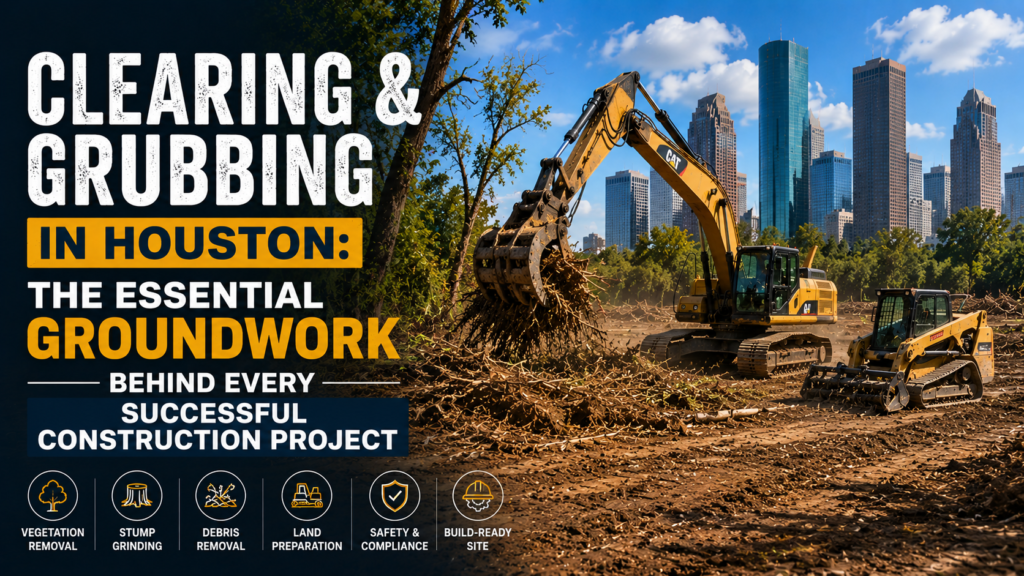
Vegetation removal is the active clearing phase. Depending on the density and size of vegetation, this may involve bulldozers pushing trees and brush to designated piling areas, excavators equipped with mulching or grapple attachments processing material as it falls, skid steers working in areas too confined for larger equipment, or forestry mulchers grinding vegetation in place. The appropriate equipment combination depends on the specific conditions of each Houston site.
Grubbing follows tree and brush removal. Bulldozers and excavators are used to extract root systems and stumps from the ground. This work is more time-consuming than surface clearing because operators must ensure root systems are followed to a sufficient depth, particularly for large trees whose roots may extend several feet below grade. The excavated material is collected for disposal.
Waste management addresses the substantial volume of material generated by clearing and grubbing. In Houston, cleared material may be processed on site through chipping or mulching where conditions allow, hauled off to approved disposal facilities, or where burning is permitted under applicable regulations burned in controlled conditions. Responsible waste management is part of any well-managed clearing and grubbing operation.
Site preparation for grading typically concludes the clearing and grubbing phase. Once the site is cleared of all above and below-grade organic material, it moves to grading the process of shaping the land to the specified elevations for drainage and construction.
Equipment Used in Clearing and Grubbing
The scale and type of clearing and grubbing equipment brought to a Houston project reflects the scope and conditions of the site. Bulldozers are the workhorses of large-scale operations, capable of pushing substantial trees and processing large volumes of material efficiently. Excavators provide precision and lifting capacity that bulldozers cannot, and they can be fitted with different attachments buckets, grapples, thumbs, and shears to handle different tasks.
Skid steers with mulching or grapple attachments are well-suited to smaller lots and areas requiring more precision. Dump trucks and haul equipment transport cleared material off site. Stump grinders specifically address stumps that need to be ground rather than extracted. On projects where forestry mulching is the chosen approach, purpose-built high-horsepower mulching machines process trees and brush simultaneously, leaving a ground-level mulch layer.
Environmental Responsibilities
Clearing and grubbing in the Houston area must comply with regulations designed to protect drainage, prevent erosion, and minimize environmental impact. Projects disturbing more than one acre are required under the Texas Pollutant Discharge Elimination System (TPDES) to implement and maintain erosion controls throughout the clearing and construction process. These typically include silt fencing, sediment traps, and ground cover practices to prevent disturbed soil from washing into drainage systems and waterways.
In areas near wetlands, floodplains, or other environmentally sensitive resources all of which are common in the Houston region given its bayou network and coastal proximity additional permits and mitigation requirements may apply. Experienced clearing and grubbing contractors know how to identify these conditions and ensure their operations remain in compliance.
Connection to Broader Site Development
In the full sequence of land development, clearing and grubbing is typically the first field operation. It comes after planning and permitting but before grading, excavation, utility installation, and foundation work. Getting this first step right thorough, precise, and compliant sets the conditions for every phase that follows.
In Houston’s land development market, where the scale of activity ranges from individual custom home construction to master-planned community development, clearing and grubbing is performed by contractors whose experience and equipment capabilities span a similar range. Matching the right contractor to the right project based on site conditions, acreage, regulatory requirements, and downstream construction needs is the starting point for any successful land development venture.